Ep. 51 – WITA’s Friday Exchange: Coffins, Paint Rollers and Other Threats to National Security – Time to Update US Trade Laws?
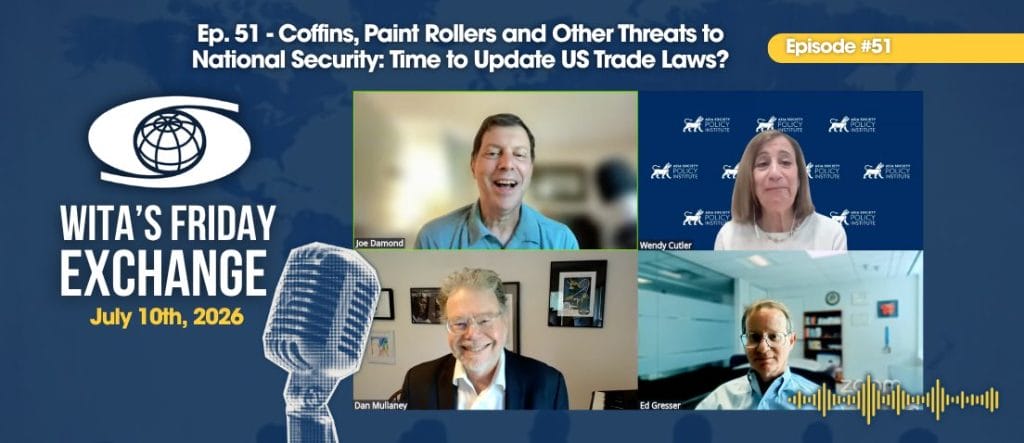
Watch or listen on Spotify or Apple Podcasts.
Former Trade Negotiators Discuss This Week’s Tariff Trade Developments.
No one understands the dynamics with key U.S. trading partners better than the people who led these kinds of difficult trade negotiations for the United States. Panelists will update our viewers on the trade policy announcements, what remains undone; and what are expected next steps in these trade negotiations.
In this week’s episode, our trade insiders discussed the Spain tariff threat and its quick reversal, and what that sequence of events suggests about navigating President Trump’s tariff threats in a post-IEEPA world. The panel also examined how “national security” is being applied as a basis for tariff action across a wide range of products and countries, and discussed the ongoing question about the Congressional role role in setting trade law given the Cold-War era measures like Section 301, 122, and 232 are being used for 21st Century economic and national security purposes.
Our trade experts then turned to the Section 301 investigation on forced labor, including a firsthand account of this week’s USTR hearings, the standards at issue, and the potential for future litigation. The insiders also covered a joint statement from industry groups representing the apparel and textile sectors, recent developments in the excess capacity case, and a new Section 232 finding on aircraft parts that may point to a broader pattern in how these investigations are being resolved.
Featured Speakers:

Wendy Cutler
Senior Vice President; former Acting Deputy U.S. Trade Representative
Asia Society Policy Institute
Wendy Cutler is Senior Vice President at the Asia Society Policy Institute (ASPI), based in Washington, D.C. In this role, she focuses on leading initiatives that address challenges related to trade, investment, economic security, and innovation, as well as women’s empowerment in Asia.
Cutler joined ASPI following an illustrious career of nearly three decades as a diplomat and negotiator in the Office of the U.S. Trade Representative (USTR), where she also served as Acting Deputy U.S. Trade Representative. During her time at USTR, she worked on a range of bilateral, regional, and multilateral trade negotiations and initiatives, including the U.S.-Korea Free Trade Agreement, the Trans-Pacific Partnership, U.S.-China negotiations, and the WTO Financial Services negotiations.
Cutler has published a series of ASPI papers on the Asian trade landscape and serves as a regular media commentator on trade and investment developments in Asia and the world.

Ed Gresser
Vice President and Director for Trade and Global Markets
Progressive Policy Institute
Ed Gresser is Vice President and Director for Trade and Global Markets at PPI. Gresser rejoined PPI in 2021, after an earlier tour from 2001 to 2011. Before rejoining, he served from 2015 to 2021 as the Assistant U.S. Trade Representative for Trade Policy and Economics at the Office of the United States Trade Representative (USTR), where he led USTR’s economic research unit, oversaw the Generalized System of Preferences, and chaired the 21-agency Trade Policy Staff Committee.
Gresser began his career on Capitol Hill before serving at USTR as Policy Advisor to USTR Charlene Barshefsky from 1998 to 2001. He then led PPI’s Trade and Global Markets Project from 2001 to 2011. After leaving PPI, he co-founded and directed the independent think tank ProgressiveEconomy until rejoining USTR in 2015.
Gresser is a graduate of Stanford University and holds a master’s degree in International Affairs from Columbia University, along with a certificate from the Averell Harriman Institute for Advanced Study of the Soviet Union. He is the author of Freedom from Want: American Liberalism and the Global Economy (2007), has published in a variety of journals and newspapers, and regularly testifies before congressional committees on trade and global-economy topics. His research has been cited by leading academics and international organizations including the WTO, World Bank, and International Monetary Fund, and has been covered by outlets ranging from the New York Times and Washington Post to Vogue, NPR, CNN, Politico, the Wall Street Journal, and the Financial Times.
In 2013, the Washington International Trade Association presented Gresser with its Lighthouse Award, given annually to an individual or group for significant contributions to trade policy.

Daniel Mullaney
Non-Resident Senior Fellow; former Assistant U.S. Trade Representative for Europe and the Middle East
Atlantic Council
Daniel Mullaney is a nonresident senior fellow with the Atlantic Council’s Europe Center and GeoEconomics Center. Most recently, he served as assistant US trade representative (AUSTR) for Europe and the Middle East in the Office of the United States Trade Representative (USTR) from 2010 to 2023. He was chief negotiator for comprehensive trade agreements with the European Union (EU) and the United Kingdom, as well as trade lead for the US-EU Trade and Technology Council, and was responsible for developing and implementing US trade policy in Europe, Eurasia, Russia, the Middle East, and North Africa.
Before assuming the post of AUSTR, he served as senior trade representative in the US Mission to the European Union in Brussels, where he was the principal voice for US trade policy in interactions with the EU institutions and EU member state governments, the public, and the international press. Prior to that posting, Mullaney was in USTR’s Office of General Counsel for seven years, where he represented the United States in dispute settlement proceedings at the World Trade Organization and led negotiations and acted as legal counsel for free trade and other agreements. Before joining USTR, Mullaney was in private practice for nearly twenty years, specializing in international trade law and litigation; when he entered public service, he was a partner at the law firm of Dorsey and Whitney.
Mullaney is a native of Cincinnati, Ohio. He holds a BA from Amherst College, and a joint law/foreign service JD/MSFS degree from Georgetown University.

Joe Damond
Non-resident Senior Associate; former Deputy Assistant USTR for Asia
Center for Strategic and International Studies (CSIS) Southeast Asia Program
Joe Damond Trade and Health Policy Consultant
Joe Damond’s career spans more than 40 years in both the government and private sectors in Washington. He served 16 years as a trade official at the Department of Commerce and the Office of the United States Trade Representative, holding a diverse set of responsibilities across that time.
Most notably, Damond spent seven years as Deputy Assistant United States Trade Representative for Asia and the Pacific, where he was responsible for executing U.S. trade policy with Southeast Asia and the Asia-Pacific Economic Cooperation forum. He served as chief negotiator of bilateral trade agreements with Laos and Cambodia, as well as the historic Bilateral Trade Agreement with Vietnam, concluded in 2000, and also chaired the Asia-Pacific Economic Cooperation Committee on Trade and Investment.
Damond then spent more than 20 years in the private sector, holding senior positions in the pharmaceutical and biotechnology industries focused on international trade, health policy, and global government affairs, representing the sector during numerous bilateral and global trade agreements. For the past four years, he has worked as a consultant on healthcare and trade policy issues, representing both private sector and government clients with a focus on Asia and Europe.
Damond is the author of Give Trade a Chance: The Negotiation of the U.S.-Vietnam Bilateral Trade Agreement.